
Brenna Mancini
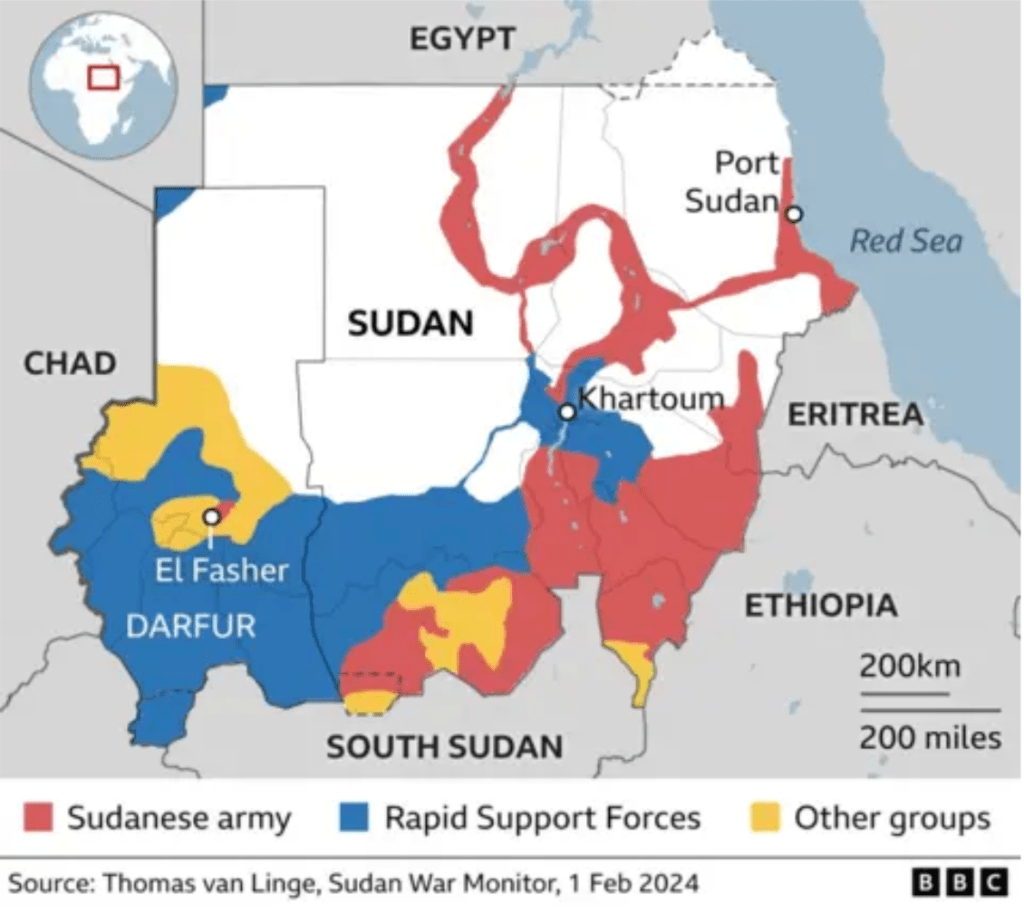
The city of El Fasher, located in Western Sudan, is on the brink of collapse. In April 2023, a civil war broke out between the Sudanese armed forces (SAF) and the paramilitary group the Rapid Support Forces (RSF). On May 10, 2024, the RSF began its attack on El Fasher. The city was under siege for 535 days, making it the last central town in the Darfur region under government control. On October 27, 2025, the RSF officially took El Fasher.
Roots of the Conflict
Sudan’s current conflict began in 2019 with the overthrow of President Omar al-Bashir. President al-Bashir had been in power for over three decades before his expulsion by the people of Sudan, and his ousting brought a protracted power struggle between the government and the RSF. In October 2021, the established military-civilian government was overthrown by General Abdel Fattah al-Burhan, leader of the SAF, and his deputy general, Mohamed Hamdan “Hemedti” Dagalo, leader of the RSF. Consequently, another power struggle ensued, with both men wanting to maintain their positions rather than transition to democracy. On April 15, 2023, the conflict came to a head as the SAF and RSF began shooting at each other.
Since then, the RSF has gradually expanded its control over the Darfur region. Although currently considered a civil war, evidence suggests that the conflict is evolving into a violent proxy war. The SAF has received support from Saudi Arabia, Egypt, Turkey, Iran, and Russia. The United Arab Emirates has come under fire for funding the RSF and supplying British weapon technology. Additionally, Ukrainian special forces were found to have joined the RSF in response to Russian involvement. The United States has also been criticized for its complacency on the issue, refusing to acknowledge the violence its richest ally, the UAE, has funded. During the UN’s October 27 briefing, Secretary-General António Guterres explained that “the problem is not only the fighting between the army and the Rapid Support Forces, but also the growing external interference that undermines prospects for a ceasefire and a political solution.”
Isolating El Fasher
Located in West Darfur, El Fasher was the SAF’s last stronghold in the Darfur region. Since its siege, the RSF built sand berms and military postings, effectively isolating the city from the outside world. One of the most significant challenges in providing aid to El-Fasher came from the RSF’s lockdown. The World Food Programme attempted to bring food, water, and money to civilians inside the city; however, the RSF’s siege created limitations on the amount of resources that could be brought in.
This famine has been estimated to have killed thousands, with those trapped in the city forced to eat animal feed. The World Food Programme declared the El Fasher famine to be the largest hunger crisis in the world. Almost half the population of Sudan was facing food insecurity, with approximately 674,000 people facing “catastrophic hunger levels.” This weakened the SAF, providing the RSF with the opportunity to gain an advantage and drive the Sudanese military out of the city
A History of Human Rights Violations
The RSF’s control of El Fasher has raised concerns about the safety of the citizens trapped inside. Throughout the conflict, the RSF has committed numerous human rights and international law violations. The paramilitary evolved from the Janjaweed militia, a notoriously violent group accused of genocide and ethnic cleansing. The Yale Humanitarian Research Lab used satellite imagery analysis on October 27 to observe evidence of these mass killings. Evidence, such as vehicle blockages, reddish ground discoloration, and objects consistent with the sizes of bodies, has all been evaluated by Yale’s HRL to make these determinations.
On October 28, the World Health Organization reported that an El Fasher hospital had been raided and over 460 patients were massacred by the RSF. Videos circulating online, presumed to have been taken by RSF members, show soldiers stepping over bodies as they execute anyone they encounter. Since taking control over the city on Monday, the RSF has been accused of killing over 2000 civilians. Médecins Sans Frontières has documented mass atrocities in El Fasher, including the detention and abduction of hundreds of citizens. Sexual violence, starvation, water deprivation, and cases of torture have all been reported since the start of the conflict. While RSF leader Mohamed Hamdan “Hemedti” Dagalo has claimed he will hold those soldiers accountable, the conflict stretches into its third year with no action being taken.
The Future of Sudan
The RSF continues to commit human rights violations with no consequences. This violence is on the verge of becoming genocidal, as reports of ethnic cleansing continue to be released. The RSF’s complete control over the Darfur region has prevented anyone in the city of El Fasher from getting help. Since the start of the conflict, over 150,000 Sudanese have been killed, with over 12 million displaced. These numbers will continue to grow as the conflict has no end in sight. Due to the isolation, the United Nations is extremely limited in providing humanitarian relief. Additionally, the UN’s inability to use military force and its limited resources have hindered peacekeeping missions.
As the paramilitary group continues to expand control across the Darfur region, Sudan may be at risk of splitting. Since the secession of South Sudan in 2011, Sudan has become increasingly unstable politically and socioeconomically. The RSF’s formation of its own government in July, known as the Leadership Council of the Sudan Founding Alliance (TASIS), has raised concerns over a potential split. With the RSF’s takeover of the region’s capital city, Sudan sees the secession of its western region.
 Global Eyes: A Student Publication