
Antonio D’Alesio
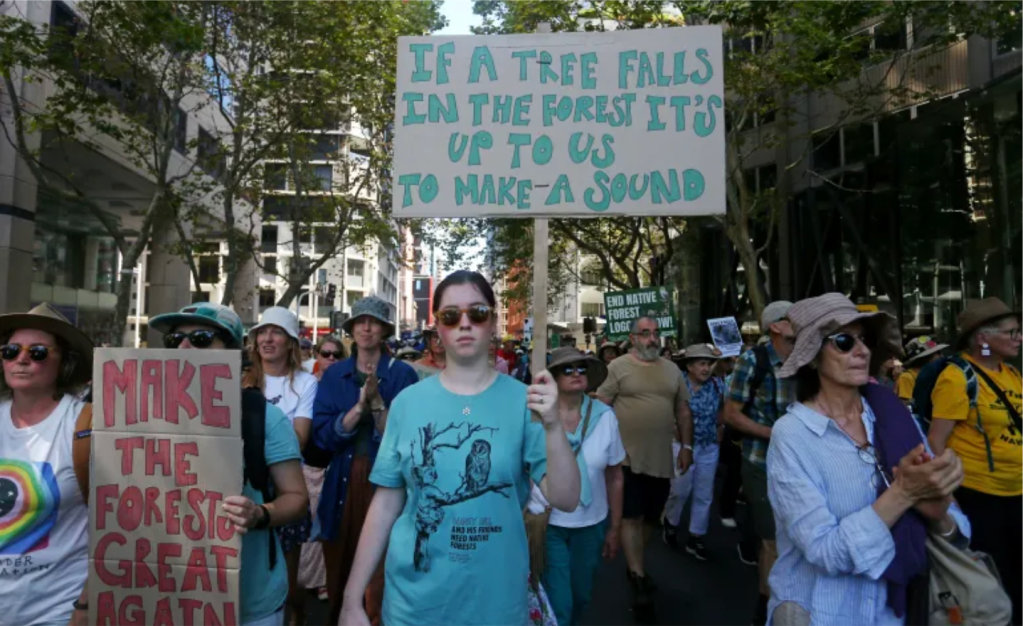
In recent years, the Australian government has embarked on a clear shift in how it responds to the urgent climate crisis—introducing legislation that prosecutes protesters with criminal penalties. This shift reveals a profound disconnect between public demands for environmental justice and the state’s enduring priorities, which focus on order, infrastructure, and economic continuity. The surge in climate protests, characterized by bold tactics such as blockading coal ports, disrupting transport links, or targeting infrastructure, reflects a growing impatience among activists and a broader public who feel that conventional political channels are failing to deliver adequate responses to the urgent climate emergency.
At the same time, several Australian states have passed laws that categorize such protest tactics as serious offenses; for example, in New South Wales, a 2022 amendment allows up to two years’ imprisonment or fines of up to AU $22,000 for blocking major roads or public facilities. This legislative measure, and the way it has been enforced, suggests that the state is responding less to the moral urgency voiced by citizens and more to maintaining uninterrupted flows through ports, roads, tunnels—and by extension, fossil-fuel infrastructure and existing economic frameworks.
Many contemporary climate activists argue that the climate crisis represents both an intergenerational injustice and a threat to human rights, particularly for communities that are least responsible for emissions yet most vulnerable to harm. These activists are demanding structural changes to address the climate crisis, such as transitioning to renewable energy and reducing carbon emissions. Therefore, protest is not mere disruption, but a democratic expression calling for these structural changes.
Against this backdrop, the new laws appear less like neutral regulations and more like mechanisms to defend the status quo. As human-rights organizations have pointed out, the laws appear targeted: in New South Wales, for example, peaceable climate protesters have been jailed or seriously penalized under laws introduced specifically after infrastructure-blockade actions. The disparity becomes starker when one considers that Australia leads the world in arresting climate and environmental protesters: more than 20% of such protests result in arrests in Australia, well above the global average of around 6.3%. In effect, the state response treats activism as a public-order problem rather than a citizen-driven moral imperative.
This rupture between public demands and state priorities operates along multiple dimensions. First, there is a democratic dimension: protest is a core form of political expression and a vital means of citizen engagement. When laws significantly penalize certain forms of protest, particularly those targeting the core components of the existing economy, the field of permissible dissent shrinks, and voices pressing for profound structural change are silenced or intimidated. In this sense, the criminalizing of protest underlines a shift from recognizing dissent to controlling disruption.
Second, there is an ecological dimension: the explicit prioritization of safeguarding infrastructure over enabling broader citizen demands suggests that the state sees the climate transition as a matter of managing disruption rather than as a transformational justice project . The criminalization of protest, therefore, signals that the state prioritizes maintaining existing systems—especially those tied to resource extraction—over aligning with the accelerating public call for climate justice and systemic change.
Moreover, the strategic effects are intensifying the divide. With protest spaces constrained, activists may be driven to more radical tactics or an oppositional stance that further distances them from avenues of constructive dialogue. Some activists themselves describe the criminalization of protest as validating their argument that existing institutions are unresponsive or complicit in climate delay. As one legal analyst noted, “people who are engaging in protest generally are happy to take the risk of being jailed or fined large sums of money because they’re motivated by the cause.” And when such risks are realized—with heavy penalties, long bail conditions, or surveillance—the logic of protest shifts into confrontation rather than cooperative reform. This shift could lead to a more confrontational and less cooperative form of activism, potentially hindering the possibility of reaching consensus on the climate transition.
At the same time, the state justification is anchored in preserving infrastructure and economic functioning. Government statements emphasize the need to protect major facilities, roads, rail, bridges, and ports from disruption, citing the costs, safety, and productivity implications. For instance, the law in New South Wales was introduced in direct response to protests aimed at major roads or ports, framed as causing “severe financial impacts” through lost productivity.
These framing positions protest less as a political act and more as a disruption to collective livelihood, shifting the narrative away from environmental justice and onto economic imperatives. In this light, the criminalizing legislation is best understood not only as a legal response, but also as a signal of state priorities: infrastructure continuity and economic stability are elevated above the voices calling for urgent change. The media’s significant role in shaping public perception of the protests and the state’s response—thereby influencing public opinion and policy decisions—cannot be overlooked.
The outcomes of this rupture are consequential. Democratically, we see a potential chilling effect on protests, reduced trust in governance, and a narrower window for citizens to press for transformative change. Environmentally, we may see the unintended consequence of pushing activism into more clandestine or radicalized forms, reducing the chance for deliberative policy reform or public-institutional engagement. However, there is still potential for consensus on the climate transition, which could bridge the divide between citizens demanding systemic change and the state defending its infrastructure and economic routines.
Nevertheless, the rupture is not yet irreparable. Bridging the gulf between public demands for environmental justice and state priorities will require a recalibration of both policy and perception. For governments, recognizing protest not just as a disruption to be penalized, but as a legitimate democratic channel, is vital. This means that laws targeting protests should be proportionate, clearly defined, and subject to rigorous human-rights oversight. Past criticism from groups such as Greenpeace Australia Pacific illustrates how the American-style “rush” of anti-protest laws was accompanied by statements highlighting democratic erosion.
On the activist side, sustained engagement with institutional pathways, building alliances with other coalitions, policy scrutiny, and mass participation (beyond mere disruption) help shift the framing of climate action from conflict to a shared societal transition.
Simultaneously, the state must align infrastructure and economic policy with the imperatives of decarbonization, rather than simply defending current flows from disruption. The state’s policies must align with citizen demands for environmental justice, highlighting the importance of public voices in shaping the future of climate policy and civil rights in Australia.
From a practical standpoint, policy instruments to facilitate this alignment could include structuring transition plans for fossil-fuel regions that incorporate citizens’ voices, designing infrastructure projects that embed climate justice (rather than oppose it), and creating legal frameworks that safeguard climate dissent while protecting public order. The notion of “just transition” becomes central here: activists often link climate justice with fairness—inter-generational equity, community inclusion, Indigenous sovereignty, and social rights. When state policy treats climate change as merely a regulatory matter of emissions or infrastructure and regards protest as a criminal act, it rejects this broader justice framing. By incorporating these dimensions, the state can better align with public demands, rather than treat them as antagonistic.
Overall, Australia’s legislative crackdown on climate activism reveals a fundamental misalignment: while many citizens demand urgent, equitable, and systemic responses to climate change, the state responds by guarding existing infrastructure and economic interests, and criminalizing disruption. That misalignment, that rupture, is consequential—it risks eroding the democratic license to protest, deepening alienation between citizens and institutions, and weakening the prospects for a just climate transition. If this rupture is not addressed, the legitimacy of both the state’s climate action and the activism it seeks to contain may be undermined—and the window for meaningful change is likely to narrow, even as what is truly required is expansive transformation.
 Global Eyes: A Student Publication