
Zoë Perri
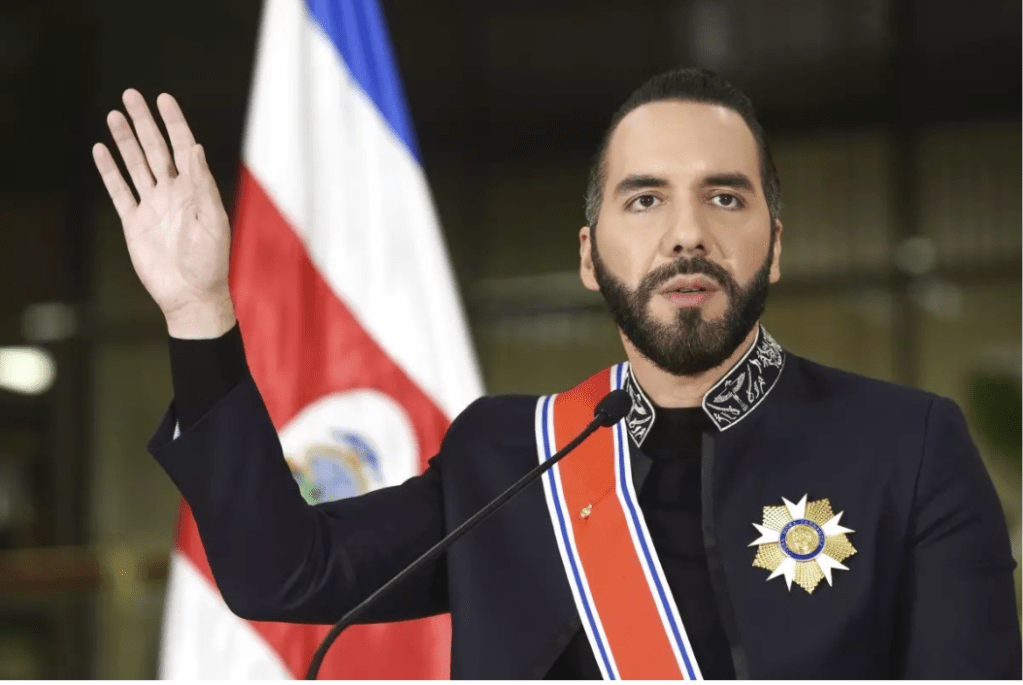
El Salvador, long known for its high murder rate and deep-seated gang violence, has seen crime and gang violence fall by 70% over the last six years. But at what cost? President Nayib Bukele has taken the country by storm, campaigning for a safer, more orderly nation free of gangs and violence. Bukele’s crackdown on crime has led to increased public approval and praise from citizens of El Salvador. Consequently, Bukele’s “war on gangs” has given the public the impression of safer communities throughout the country. Bukele’s promise of reform and subsequent high citizen approval have enabled him to retain his position of power, despite the use of extreme measures to jail citizens and increasingly authoritarian policies.
Democratic Backsliding or Stricter Policies?
Bukele has had the advantage of his policies being viewed as simply stricter instead of an authoritarian turn. Oftentimes, the removal of horizontal checks on executive power can generate systematic advantages for the leading party. Following his first term, Bukele used his legislative majority to amend El Salvador’s constitution in 2021, allowing him to run for a second term. His re-election resulted in an 84.7% majority vote, establishing the first two-term presidency in El Salvador’s democratic era. Another revision of electoral laws followed, as the administration reduced legislative seats from 84 to 60, thereby reinforcing his supermajority. In July 2025, Bukele’s administration amended the constitution once again, removing presidential term limits entirely. Consequently, a system with few legislative checks on executive power exists.
These constitutional amendments are possible because Bukele has weakened legislative and judicial power. Judicial institutions generate changes in favor of the ruling parties can be seen through strategies that reinforce antidemocratic ideals, such as court packing and altering judicial processes. For instance, throughout his first term, Bukele dismantled the Supreme Court of Justice (SCJ). He dismissed judges aged 60 and older, along with any who had served more than 30 years, framing it as an anti-corruption measure. By removing older judges from the judiciary, the current administration has successfully appointed judges who are loyal to Bukele’s policies. So, when looking at El Salvador and Bukele’s policies upfront it is easy to see how he has slowly broken down the democratic norms within the country.
Commonly, efforts to dismantle democracy are framed as a means of protecting democracy. Notably, as seen in both Hungary and Venezuela, systematic changes to democracy can be implemented most effectively when the public is divided, fearful, and seeking change. Leaders can label opposition or a group of people as a common threat to democracy, and use them to critique current democratic institutions.
Bukele has used this tactic to imprison over 83,000 people under a prolonged state of emergency. He declared a State of Emergency beginning in March of 2022, and any citizen found to have relations to gangs or gang violence has since been arrested. Subsequently, Bukele has retained a firm hold on the prison system through mass incarceration policies, deadly prison conditions, and the use of these policies to go after opposition forces. Ultimately, the implementation of fear of crime and the fear of another group has fostered the illusion that Bukele is improving the lives of citizens when in reality he is imprisoning masses. By decreasing crime rates overall, even if that includes jailing citizens, Bukele reinforces his own legitimacy and is seen as an effective leader. Consequently, his manipulation of this issue makes it harder for citizens to view his policies as inherently anti-democratic.
Citizen Approval as an Indicator of Erosion
Bukele’s high citizen approval stems from his ability to reinforce his legitimacy. Instead of openly displaying his authoritarian tactics and policies to dismantle democracy, Bukele uses his promises of restoring national order as a way to boost his approval. The public’s desire for stability is large enough that Bukele continues to appear as a desirable political leader and the room for citizens checking his power shrinks. Ultimately, it is extremely difficult for civil society to view policies and attacks on freedoms as a humanitarian issue.
Over the past year, some pushback towards Bukele’s policies has begun. Protests in May and September 2025 occurred, voicing concerns about human rights violations. Unfortunately, the criminalization of protests has further silenced the opposition and instilled a new fear among citizens. So if there is a sense of public discontent, shouldn’t some reform follow? These examples of protests demonstrate attempts to establish some accountability for Bukele; however, without adequate judicial and legislative checks on executive power, citizens are at a loss to combat democratic erosion. Evidenced by these protests, the people of El Salvador has reached their limit of anti-democratic policies.
Due to the country’s institutionally unstable state, citizens have found solace in what Bukele has preached. Consequently, citizens have supported democracy even when it’s breaking democracy itself. Accountability is not possible when citizens perceive harmful policies as democratic and little change in El Salvador is likely to occur. Buckele’s ability to reestablish legitimacy has created the space to reduce citizen’s desire for democracy, and to allow him the power to continue his rule.
 Global Eyes: A Student Publication