
julianne needleman
Since October of 2023, Israel has launched a full-scale war on the Gaza Strip, killing tens of thousands and displacing hundreds of thousands more. This war is not Gaza’s first with Israel. It has been marred by violence nearly non-stop since the creation of the state of Israel in 1948, beginning with the mass displacement and dispossession of Palestinians known in Arabic as the “nakba,” or catastrophe. Already a wartorn region, Gaza has seen unprecedented violence in the past year and a half. Approximately 1.9 million people, the majority of whom are children, have been forcefully displaced as a result of the war, deemed a genocide by Amnesty International and numerous UN experts. Uprooted from their homes and torn from their families, these refugees end up in overcrowded, poorly equipped camps where disease spreads easily, especially among children whose already weak immune systems have been crippled by extreme stress, hunger, and exhaustion.
Which diseases are spreading among Palestinian refugees?
Palestinian refugees are facing a myriad of outbreaks of infectious disease, but the most common fall into two categories: vaccine-preventable diseases like polio and hepatitis, and diseases caused by sewage runoff like cholera and skin infections. Khan Younis and Deir al-Balah, two sites containing some of the largest camps of Palestinian refugees, have detected polio and cholera in their wastewater, indicating widespread and serious outbreaks among the vulnerable populations in these refugee camps.
Why does disease spread so easily in Palestinian refugee camps?
Gaza has been in a state of relentless chaos since Israel waged war on it following the attacks in southern Israel on October 7. Mass vaccination campaigns have been nearly impossible to carry out as hundreds of thousands are forcibly displaced to areas within and outside of Gaza. Additionally, the dangerous conditions in the area make it so that there are fewer aid workers willing to carry out a vaccination campaign. The particular variant of polio circulating around Gaza, vaccine-derived poliovirus type 2, tends to affect regions where vaccination rates are particularly low. This variant emerged from a vaccine, where the weakened version of the virus used in the oral polio vaccine spreads from child to child. Vaccine-derived poliovirus type 2 is every bit as dangerous as wild-type polio; however, and its propagation in Palestinian refugee camps poses an extreme risk to global public health.
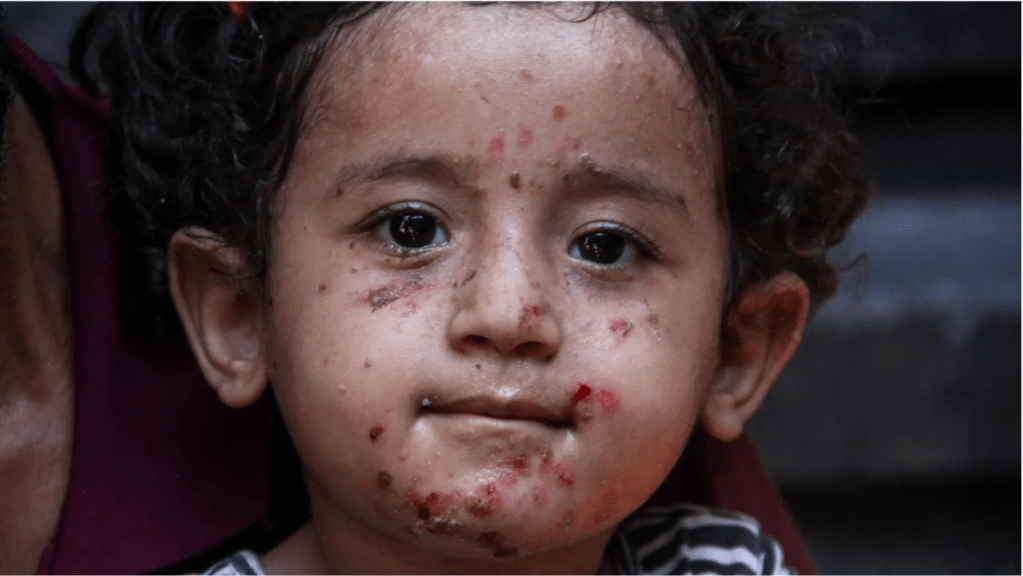
Polio is not the only health risk that Palestinian refugees are facing. According to a 2024 UN environmental report, the incessant Israeli bombardment has collapsed Gaza’s already overwhelmed wastewater management system. This lack of proper sanitary infrastructure in refugee camps leads to sewage runoff contaminating residences, causing outbreaks of painful, disfiguring skin infections, especially among children.
The raging violence has also destroyed many of Gaza’s largest hospitals, with only four left functioning out of thirty-six. The destruction of hospitals within the Strip has been especially concentrated around its most populated urban centers, Gaza City and Khan Younis, with the latter having no fully functioning hospitals to serve its estimated population of over 200,000, in addition to the refugee camps in the surrounding area.
Additionally, the immune system functioning of Palestinian refugees is depressed on an individual level because of extreme stress, famine, and exhaustion. The body’s response to stress is to release the hormone cortisol, which in the short-term facilitates immune function by curbing inflammation. However, prolonged heightened levels of cortisol decrease lymphocyte, or white blood cell, count. White blood cells are the immune system’s critical first line of defense against pathogens. In an overcrowded environment with exposure to contaminated wastewater populated by refugees facing extreme stress and low lymphocyte counts, deadly diseases will proliferate easily.
Palestinian refugees from Gaza are also at high risk of famine. Israel has cut off nearly all aid to Gaza throughout the war and destroyed the little internal food production infrastructure it had, effectively starving the people of Gaza. The north of Gaza has been cut off from the south, and it has been blockaded from foreign aid. Malnutrition and dehydration have run rampant in Gaza, with thirty-four deaths reported by the United Nations. The quality of food that Palestinians have access to is poor at best, with many refugees eating one meal per day at most consisting of stale bread, with significant sources of protein and micronutrients like vitamin C being scarce, if available at all. A healthy, functioning immune system depends on consistent and varied sources of nutrition, which Palestinian refugees do not have. Malnutrition represses immune function, especially as it relates to lymphocyte and T cell activity, increasing the body’s susceptibility to viral infection.
The population of Gaza also has a disproportionately high ratio of children to adults. Almost 40% of its citizens are children, with almost 600,000 being under 10 years of age. Children have weaker, underdeveloped immune systems and as such are more susceptible to viral infection. Polio especially has a debilitating effect on children, rendering many paralyzed. It is spread through direct contact like touch and respiratory droplets, as well as through fecal matter. Children are more likely to come into contact with contaminated individuals and surfaces, especially before they learn hygienic bathroom practices. Poliovirus also takes advantage of the comparatively weak immune systems of children, which are only made weaker by the conditions in the refugee camps in which they are forced to live.
The conditions in Palestinian refugee camps, both on an individual and community level, create a perfect storm where disease spreads easily and manifests as more deadly than it would in other populations.
What needs to be done to stop the spread of disease in refugee camps?
The most imperative first step in addressing the spread of disease among Palestinian refugees is an immediate end to the violence Israel is inflicting on Gaza. The government of Israel must agree to a ceasefire and hold itself to that agreement. A ceasefire ends the violence displacing millions of Palestinians and relieves the inordinate stress they are facing. Moreover, a ceasefire will allow aid workers to carry out a mass vaccination campaign for polio and hepatitis, saving millions of Palestinian lives. The international community must take a stand against the genocide Israel is carrying out on the Palestinian people and directly address how it rears its ugly head, especially as it relates to deadly, yet preventable infectious disease spreading among some of the most vulnerable populations on the planet.
 Global Eyes: A Student Publication