
priyanka Iyer
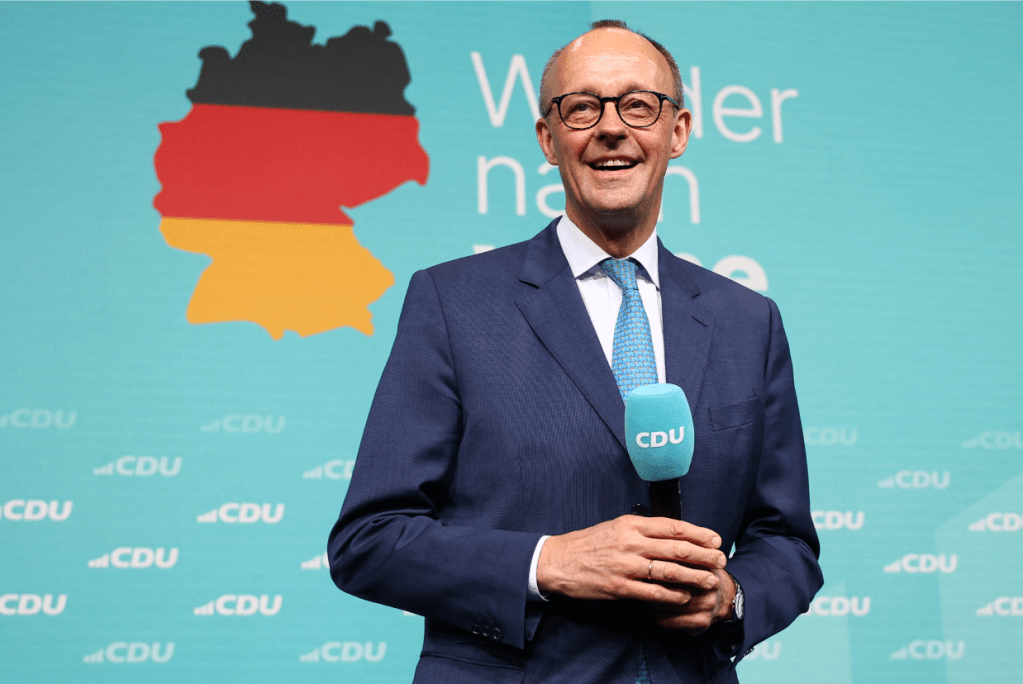
When the dust settled after Chancellor Olaf Scholz’s government was dissolved, Christian Democrat Friedrich Merz became poised to take control–with lofty plans. The former BlackRock executive will inherit a twenty-years-stagnant economy (and a middle class that has begun to take notice), fracturing relations with the United States, and a dire need for European unity, something the Union has not seemed to be able to find amid Russian invasions and the renewed threat of Trumpism looming above. What exactly has Merz been thrust into? Let’s break it down.
The German System
The German political system is set up much differently than the American government is used to. A representative body called the Bundestag (or parliament) is in charge of appointing a chancellor as the head of the federal government; the President of Germany leads the Bundestag, similarly to the American Speaker of the House. Where it can get murky is the multi-party system and the coalitions that form between them; the reason Friedrich Merz was elected in the first place was a loss of confidence in Olaf Scholz, causing a decision to dissolve parliament by the President and subsequent general elections on February 23rd. The Christian Democratic Union (CDU) was the favored party to block out the far-right Alternative für Deutschland (AfD), a faction that has rightfully set off long-dormant alarms across the Bundestag due to its populist nature, which has been its recipe for a slew of recent local successes.
Tired Economy, Restless Populace
German and EU economic policies are in a precarious position after the massive step back that the US has taken from the global scene. Nationalism and populism are the tried-and-true tools to sedate the disgruntled masses, as we have seen firsthand in the United States during and after President Donald Trump’s first term, and even earlier, in Berlin when Adolf Hitler took power. This is why the prospect of the AfD in power is unthinkable for the rest of the Bundestag. Hitler’s rise was in the wake of one of the worst cases of hyperinflation the world has seen. The hope of much of the legislation is that replacing Scholz with Merz will keep the government from going in the same direction that the US is headed. However, it will not work forever.
For the biggest economy in the European Union, Germany’s has been unremarkable, to say the least. Their GDP growth has been circling 0% since 2000, with two significant drops during the recessions of 2009 and 2020. This seems contradictory to Germany’s status as a powerhouse of innovation; however, as Merz said in 2023, the problem is that successful businesses almost always turn to the American markets when they outgrow the German ones. Further, the auto industry has been flailing for several years against cheaper and more reliable East Asian models. Somehow, stumbling behind has not pushed Germany’s largest and longest-standing industry towards electric vehicles, but Merz has clarified that corporate bailouts are entirely out of the question. An erratic Trump has threatened to impose aggressive tariffs, which could kill the economy for good. This brings us back to the middle class. The lack of growth in real wages, a direct effect of economic standstill, has caused a feeling of déclassement, a French term describing a population’s disillusionment and dissatisfaction – this is a very potent and very perilous thing. The AfD knows it and hopes to capitalize on it. It is up to the new Chancellor to quell, which is an incredibly tall order that he may be unable to fulfill.
Defense Spending
In the wake of Trump’s declaration of a trade war with Canada (a close European ally) in late February, the soon-to-be-elected Merz voiced his plans to beef up Germany’s military, citing the “possibility that [Trump would] no longer uphold NATO’s mutual defense commitment unconditionally.” It’s hard to understate the gravity of the American departure from the interventionist role that they have played since the World Wars. From Berlin’s standpoint, this could mean the estrangement of the largest importer of German goods, something that Merz is desperate to avoid. He and his party (including former Chancellor Angela Merkel) are staunch Atlanticists–advocates of strong military cooperation between Europe and the Americas–and are continuing to hold out hope.
On the other hand, migration away from the US could be what Europe needs. In fact, French President Emmanuel Macron has practically been betting on it. The idea of a sovereign Europe has been on Macron’s to-do for the better part of his term, and the upcoming NATO summit in June may be just what he needs for it to come to fruition, especially because Merz has “no illusions” about the growing need for an autonomous European military. The question is, however, whether Germany can afford to bankroll this new military. Since the Great Recession, a debt break has been baked into the constitution, setting a universal ceiling for national debt. That is, until this March when it was loosened to make way for this ambitious expansion and to hopefully jump-start the sleepy economy. This is a sign of significant changes, but only if the Ministry of Finance can stop misusing and cutting up the defense budget to balance their books. Moreover, it’s no secret what this military plan indicates; Europe is gearing up to protect itself because it has taken immediate notice of President Trump’s behavior and fears what he may do next.
In the newly emerging world order, Germany can step into the spotlight. The economy’s problem has been kicked down the street long enough, and President Trump’s hawkish foreign policy will force Chancellor Friedrich Merz to act decisively. Whether or not he can be Emmanuel Macron’s partner in bolstering Europe remains to be seen, but that is out of the question until he sets affairs in order at home.
 Global Eyes: A Student Publication